Blog

Transform your gym
in 5 minutes a day.

Get the no-BS morning newsletter read by 30,000 gym owners.

Why We Don’t Take Every Client (And Neither Should You)

If your primary goal is “make money”, you look for ways to sell more stuff. You productize your service: instead of coaching people, you sell DVDs. You knock your prices down. You write sales copy. You send 22 spam emails in a row. You measure success by input, not output. More clients = better. But if your primary goal is “help people win”, you quickly realize you can’t help everyone. When I speak to gyms, I ask, “How many members can you serve?” Most give me a big number, like 300, because they haven’t heard the question before. The REAL number of lives you can affect long-term is closer to 150 (Dunbar’s number). It’s an anthropological norm, but I’ve written about the 150-member point in several places. But even if you plan to someday reach 500 members, it’s helpful to ask yourself: What if I could only get 150 clients? What would I have to charge them to make a great living? How long would I have to keep them? How can I help them BEST? The best gyms don’t become the best by having the most members. The best gyms are the best because they help their members MOST. Think about the followup questions to the above: How much space do I really need to service 150? Who can afford to pay the rates I need? If I’m starting a 30-year relationship, does it really matter if their first three months are spent focusing on their diet and NOT exercising? What can I do to help these people more now that I’m not worried about chasing down 100 others? And, of course, the biggest question of all: What kind of client DOESN’T fit in these 150? As I said in Millions or Myths?, I want to save The Movement. CrossFit has given us all the entrepreneurial opportunity that we wouldn’t get otherwise. But we need models of business success, ...
Read More →

Episode 59: Ideas (2017 Edition)

Chris explains why action beats endless ideas, sharing practical strategies gym owners can implement to grow their businesses.
Read More →

To Whom Are You Speaking?

Yesterday’s post, “Are You Really Your Best Client?” was meant to spur questions like “Who IS my best client?”, “Am I really like them?”,  and “What do THEY want – and am I just doing stuff that would appeal to people like me?” My SEED clients are educated. They have high-paying jobs. They are experts in their field. They probably supervise others. If they’re looking for a coach, they have to trust the coach’s authority. What erodes that authority? Signals – overt or otherwise – that I’m less educated than they. Or less smart. Or lazy. It’s difficult to judge brainpower or intent online. We’ve all been misinterpreted, misread or misjudged. Facebook doesn’t allow for much inflection; it’s black-and-white. But spelling mistakes, grammatical errors and bad language stand out like red flags. This is SO important that I’ve asked a close friend to prepare a module on grammar for Two-Brain gym owners. We spend our days asking people to reconsider their basic squat and gait – movements they’ve practiced since birth. It requires humility to reconsider your use of language. I suggest you do it anyway. Here’s a starting point: You’re = You Are Your = It belongs to you They’re = They Are There = A Place We’re = We Are Were = Past tense of ‘Are’ Where = A Place Then = A point in time Than = A method of comparison Two = The number 2 Too = Also To = Indicates motion Of note: this blog post probably isn’t perfect. There are “grammar police” out there who delight in finding mistakes. I’m not one. Don’t allow the pursuit of perfection be the tripping-block of “good”. But someone has to say this stuff! A potential high-end client might not care about your grammar. She might overlook your misuse of “you’re” and “they’re.” Or she might not. Is it worth the gamble?
Read More →

Are You Really Your Best Client?

When I opened my CrossFit gym, I built it around what I liked. I chose bars that were great for powerlifting. I put in two GHRs and a reverse hyperextension machine. I hung chains on all my cages and put a chalk bowl in the middle of the floor. I slid a Metallica disc in the machine and hit “repeat”. The first woman to walk in the door walked right back out again. I love my clients. But they’re not like me. At least, they’re not much like the 28-year-old me. Are your “ideal” clients just like YOU? Are your SEED clients your age? Do they have 3 hours every day to work out? Are they passionate about improving their snatch? Do they earn what you earn? One of the biggest turning points in my business came when I realized that my best clients weren’t much like me at all: They earned more They cared more about clean bathrooms They wanted 1:1 attention often They didn’t like Megadeth They don’t want to think about programming They care more about smiling than PRing their overhead squat three-rep max.   What did this mean? I stopped projecting my budget onto their wallet I took the skulls off my website I stopped using the F word on social media I replaced that blinking light bulb I posted more pictures of people smiling I cleaned the blood off the bars (true story) I stopped yelling at them for chalk spills I stopped believing people just had to “want it bad enough”. I cleaned up my grammar (top earners don’t confuse “you’re” with “your”)   When I realized that I wasn’t my ideal client, I started getting cooler clients with smaller egos and fewer problems. Go figure.   One of the best reasons to do the SEED Clients worksheets in our Incubator is to discover who your best clients REALLY are, and what THEY want. That ...
Read More →

Episode 58: Starting Nutrition Programs in 2017

Nicole Aucoin shares how gym owners can add nutrition coaching to increase revenue, improve client results and build healthy habits.
Read More →

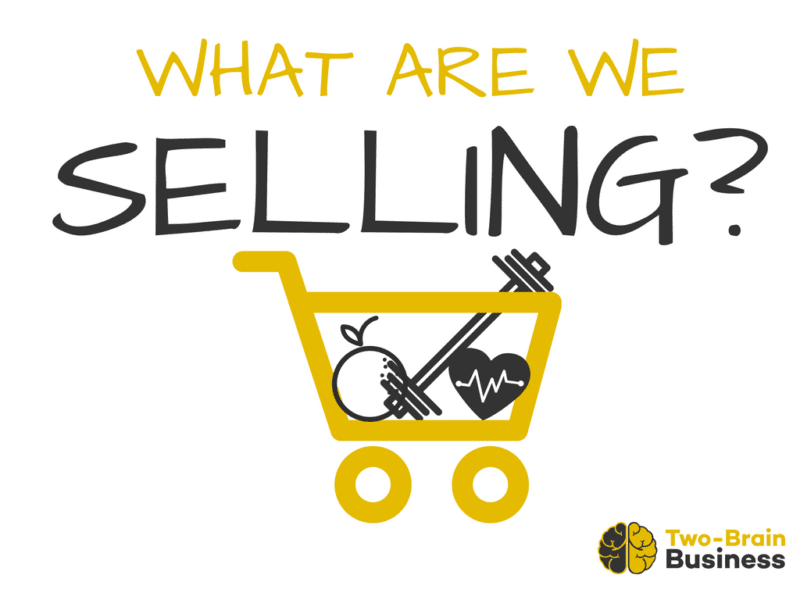
What Are We Selling?

Two months ago, I was sitting in CrossFit Bolton with two primo gym owners and three HQ staff. While the cameras were off, my friend Tyson Oldroyd was asking us about nutrition programs in our gyms. He had just successfully coached a client to lose over 100lbs with mostly dietary changes. He said something like, “We’re in the results business.” It led me to ask, “Are we selling exercise here, or fitness? Can we really sell fitness WITHOUT a nutrition prescription?” Yesterday on 2BTV (our private weekly webinar for TwoBrain mentoring clients) my guest was Nicole Aucoin, who helps gyms build nutrition programs. Most of us are adding a nutrition layer on top of the exercise program we sell. But Nicole is also in the process of opening her OWN CrossFit gym. And with a blank slate, she’s making nutrition the base of the fitness pyramid…as we all should. Starting from a blank slate, and selling fitness, let’s consider these questions: If 80% of our clients (that was the statistic from my gym in 2016) are seeking some sort of aesthetic goal first and foremost, what’s the best way to get them there? What tools are available to us? How will we measure progress? What equipment will we need to deliver this service? How many clients can we help? What if some of them were in a group? What will our prices need to be to make a good living at this? Remember: blank slate. No sunk costs, like pre-existing equipment. How will this change your perspective on business in 2017? Are we selling fitness, or exercise? What OTHER pieces are we possibly missing? – and – What opportunities do those pieces create? (You can hear Nicole’s full interview on Monday’s podcast.) The “Opportunities” module and discussion in our Incubator helps gyms see the “big picture”, add revenue streams, and help their clients get more fit.
Read More →