
My biggest mistake almost bankrupted me back in the day.
I’d been a personal trainer for 12 years. I loved my clients, and most loved me—and they were getting great results.
But I was tired. Good Lord, was I tired!
I thought the best way to “scale” was to run big groups. I’d been reading about CrossFit and following its message boards since 2006. In 2007, we tried a free “crossfit” group for our 1:1 clients.
The first class took place on a Tuesday night; we did “Lynne” as a workout. I remember turning to Mike, my other full-time trainer at Catalyst, and saying, “This is awesome. I only want to coach like this for the rest of my life!”
And it was fun. Our clients loved it. With that tiny little trial group, I made a huge decision:
I signed a lease on a new location and prepared for the masses. We even knocked out a wall to accommodate the teeming hordes of people who were sure to love CrossFit classes.
Because if I built it, they would come.
Right?
Well, that didn’t happen.
My “big group classes” had two to three people in them. I was making less running the classes than I earned as a personal trainer. The extra expense nearly bankrupted me. The extra time and work forced me into a deep depression.
One bad guess nearly killed the business and floored the family.
Why did I make that bad guess?
Overconfidence and ignorance.
Nobody was telling me not to try it, and everything I read on the gym-owner message boards said that every group-coaching gym was super successful and fun to run. Some of the CrossFit gym owners even had a beer fridge and let their clients pull a can out anytime they wanted.
What should I have done?
I should have gone from one-on-one to two-on-one training, then to three-on-one training, and then to small-group training.
Here’s how to do that, so you can avoid the mistakes I made.
Steps to a Transition
Step 1—Make a list of your one-on-one clients.
Step 2—Find two who like to train around the same time. Put a checkmark beside their names

Step 3—Start a conversation with each one individually. Like this:
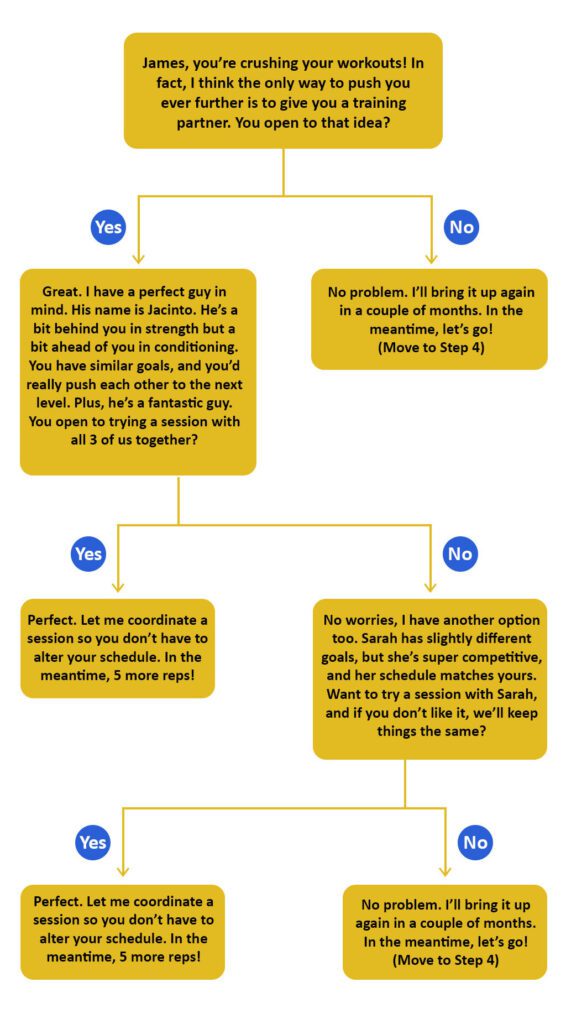
Step 4—Go back to your list. Identify eight more people who like to train around the same time. You don’t have to sort them by fitness level, experience or goals. You can train multiple people at the same time. And if you find a third person who would fit with the original two, invite them into your little “group” session. Repeat the process until you have at least 20% of your clients doing two-on-one sessions.
Step 5—Add a “small group” option to your sales binder. You don’t need to discount it because you’re probably undercharging for PT already. Instead, make your current PT rate your new rate per client in small-group training and raise your PT rate by 20%. This will encourage even more people to join your small group.
Common Mistakes
1. Treating small-group training like big-group training. Don’t open up specific hours of the day and try to fill them. Instead, group clients together. And don’t call them “classes”—Rick Mayo of Alloy doesn’t allow his franchisees to run “classes” because they devalue the product by creating confusion with large-group classes.
2. Underpricing. Your one-on-one clients aren’t there because it’s cheap. These people value coaching, schedule flexibility and having their own programs. You might think small-group training is worth “less” than PT, but you’re probably already undercharging for PT. Make the small-group rate the same as your current PT rate and raise your PT rate by 20% instead of discounting your rate for small group.
3. Running “small group” training and “big group” training concurrently. Your clients can’t see the difference in value—especially if your “big groups” have three people in them.
Small Groups: Profitable and Fun
After collecting data from tens of thousands of gyms for our “State of the Industry” report over the last seven years, I can tell you this: The small-group training model is emerging as the most profitable with the least work.
I kinda wish this wasn’t true (I do love training a big group!)—but it is.
And I have to tell you this: After nearly 30 years of coaching fitness, small-group training is a lot of fun to coach.
You want the ultimate irony?
I used CrossFit as the methodology in my big-group classes. But going from one on one to two on one to three on one to small group is actually how Greg Glassman scaled his original PT practice. He did not jump right to the big-group classes that became associated with CrossFit.
You can shift the right way, too—even if you fell into the same trap that I did back in 2008.
In the next post in this series, I’ll tell you what to do if you’re currently running big-group training and want to move to the higher-value small-group offering.