

“Our workouts are for anybody.”
Sounds like a smart statement, right?
But here’s the truth:
If you’re trying to serve everyone who wants to get fit, you’re missing the biggest opportunity in the fitness industry right now.
The future is customized.
And that means you must get really clear about who you serve—and who you don’t.
“Everyone” is a trap.
Across every service industry, the middle is disappearing.
General services are becoming cheaper and more accessible online.
That means real professionals are moving toward specialization and customization.
Look at healthcare:
- Traditional doctors—30 patients a day, seven minutes with each.
- Concierge doctors—a few hundred patients, total, who pay for premium access and a higher level of care.
Travel:
- Discount airlines—packed planes, tiny seats, awful customer care.
- Private aviation (like NetJets)—explosive growth fueled by people who want comfortable, hassle-free travel.
Hospitality:
- Large hotel chains—generic service at get-what-you-pay-for rates.
- Smaller boutique hotels—charge premium rates for personalized services and have higher occupancy rates.
The niche businesses aren’t for everyone. They are not for the person who wants to pay $59 a night for a hotel.
Niche businesses screen people out.
That’s the point. Niching means saying no.
That can feel like turning away money, excluding people and being “unfair.”
But here’s the truth: It’s your duty to say no to the wrong clients because they dilute your service for the right ones.
And even though these businesses limit their market on purpose, they are great for entrepreneurs because they’re:
- Easier to run.
- More profitable.
- Less stressful.
So why would you want to be “the Super 8 of the fitness industry”?
What the Data Says in Fitness
Here’s what we’re seeing inside the fitness industry.
Small-group and semi-private training programs outperform large-group classes.
- Large-group average profit margin: About 20%.
- Small-group average profit margin: About 28%.
So you can boost profit margin 7 or 8 points just by focusing your service.
But here’s the bigger insight:
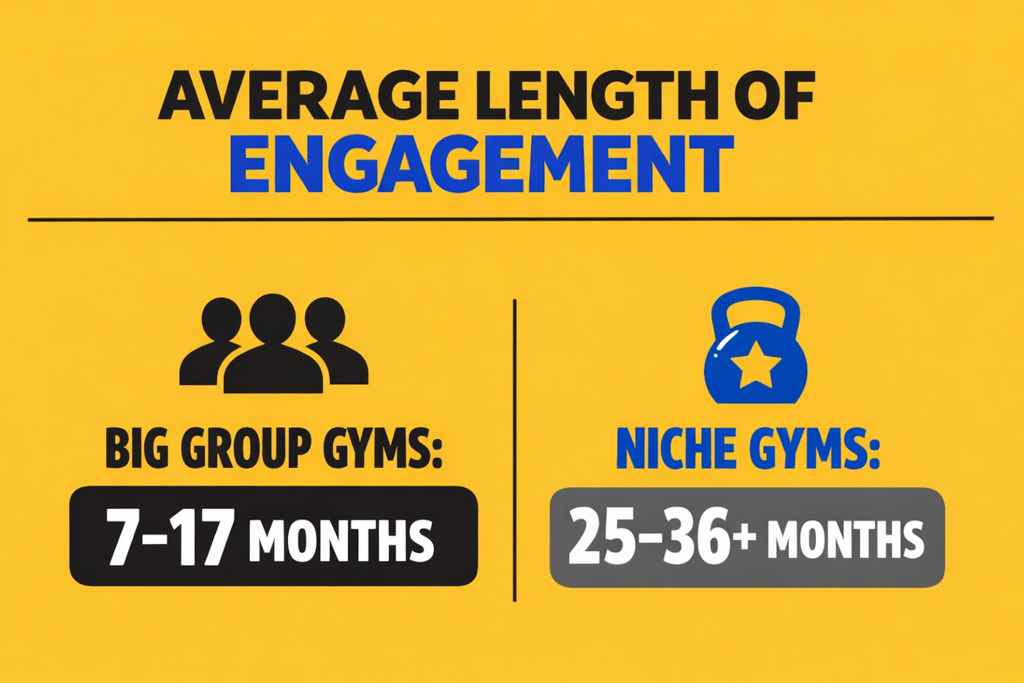
Specialized gyms retain clients longer. Let’s talk length of engagement (LEG).
- Big group gym average LEG: 7-17 months.
- Niche gym average LEG: 25–36+ months.
That’s massive.
If you charge $200 a month and hold clients for about 19 months, you’re making $2,200 less per client than if you hold members for 30 months.
And the kicker: Niche services require less marketing because clients stay longer; you don’t need to scramble to replace departing members all the time.
Why Niches Win
Niching down creates a better business in every way.
1. Marketing Becomes Easy
Instead of saying, “We help anyone get fit,” you say, “We do this for this person.”
People either see themselves—or they don’t.
No confusion.
Clarity beats confusion in marketing every time.
2. Referrals Explode
When you serve a specific group, you get more referrals because its members know each other, and they’re closely connected.
I once mined the youth track and soccer communities with great success. I went to their events, I talked to other parents, and I got a lot of great clients without advertising.
When you dig into a niche, you learn where your ideal clients gather.
You don’t need to advertise everywhere.
You just show up where your people already are.
3. Operations Get Simpler
Niching down creates focus.
Example: You stop buying equipment for “maybe someday.” You have only the equipment you use every day with your ideal clients.
No more trying to tailor space and schedule and programming to serve:
- Powerlifters
- Beginners
- Athletes
- Rehab clients
- Bodybuilders
- Seniors
- Kids
You just focus on delivering A+ service to one wonderful market segment, and your life gets easier.
4. Your Schedule Shrinks
Train teenagers? Work after school.
Train retirees? Work mornings.
And so on.
If you specialize, you can stop running classes nobody needs and trim your 5 a.m.-to-9-p.m. grind into something that allows you to have a life, too.
5. Costs Drop
If you don’t try to serve everyone, you need less space and less equipment.
When everything becomes intentional, overhead drops.
Example: Two-Brain mentor Daniel Purington operates in about 2,000 square feet, serving about 170 members who pay about $350 a month and stay for 36 months.
He’s at capacity and only accepts four new members a month.
Small space, huge revenue, no marketing.
Simple—and profitable.
6. Staffing Improves
A fact: Niche-specific coaches stay longer and perform better because they get to work with people they actually enjoy.
When your staff members serve the people who light them up, team building becomes much easier.
7. Retention Solves Itself
When clients feel like “this place is for people like me,” they stay.
You’ve probably seen the opposite: the general fitness client who is awkwardly surrounded by powerlifters, or the bodybuilder who trying to work around a sprawling CrossFit met-con. Those people don’t stay.
From Seth Godin: “People like us do things like this—there is no more powerful tribal marketing connection.”

How to Find Your Niche
Here’s the process.
Step 1: Identify Your Top 5 Clients
List the five people you love coaching—the ones you wish showed up every day.
Step 2: Look for Patterns
What do they have in common?
Age, job, goals, lifestyle, sport?
That’s your first clue.
Step 3: Test With a Small Program
Don’t change your whole business. Run a test specialty program:
- 6–8 weeks.
- Specific audience.
Examples: women only, over 50, youth athletes.
Measure: attendance, retention, satisfaction and likelihood of referrals.
If the specialty program works, grow it to 20% of your business over the next six months.
Real Example: Cyclists
When I retired as Two-Brain CEO and went back to coaching, I had to find my own clients.
“Who’s my niche?” I asked.
Cyclists. I ride every Sunday with a group. Some coach youth athletes.
So I reached out: “What if I build a program for your kids?”
They said yes.
I created a structured training plan with weekly sessions and educational content.
Parents signed up, kids brought friends and other athletes joined.
It worked because:
- I cared about cyclists.
- I understood them.
- I could talk about it all day.
The marketing became automatic because the energy was real.
Why Niches Grow Faster
Niche businesses grow through:
1. Social Proof—People see others like them succeeding.
2. Storytelling—You tell tales that resonate instantly.
3. Peer Recruitment—Clients bring their friends because they’re part of the same group. That’s how tribes form.
Caution: What Your Niche Is Not
Your niche is not your method.
CrossFit, Hyrox and Zumba are not niches.
Methods get commoditized.
Your niche is who you serve.
Examples of real niches include women over 50, youth athletes, executives, postpartum women, etc.
Interests change but identity is stable, so build around identity.
A Challenge
Look at your gym today and find the commonalities among your five favorite clients.
Test a niche program that serves more people like these clients.
Measure the results and double down if it works. Try and build the niche to generate 20% of your gross revenue within the next six months.
Remember, the future is not general.
The future is specific.
The gyms that win will be the ones that know exactly who they serve, build everything around that perfect avatar and deliver exceptional value.
Find your niche and serve it deeply. If you do, your business will be more profitable, less stressful and more meaningful.