

For the full step-by-step guide on finding, financing and closing a gym acquisition, read our companion guide: “How to Buy a Gym: The Complete Step-by-Step Guide.”
The Seller’s Biggest Mistake: Pricing on Emotion
Most gym owners have poured years of sweat, money and emotional energy into their businesses. When it’s time to sell, they want to be compensated for all of it.
Here’s the hard truth: Sweat equity equals zero dollars in a valuation.
The effort you put into building out the space, forming the community and coaching thousands of classes doesn’t add a single dollar to the sale price unless the gym is generating real profit. A buyer isn’t paying for your past. They’re paying for their future cash flow.
If you’re a gym owner who lacks strong business systems, consistent revenue and a team that can operate the gym without you, fix those problems before you think about selling.
The Foundation: Seller’s Discretionary Earnings (SDE)
Buyers price on math, not emotion. The number they care about most is seller’s discretionary earnings (SDE).
SDE in a gym represents the total financial benefit the business provides to the fitness entrepreneur. Here’s how to calculate it:
SDE = Owner’s Compensation + Add-Backs + Net Profit
Owner’s Compensation
This includes everything the owner takes from the business: salary, draws and distributions. Use the full annual figure.
Add-Backs
These are personal expenses the business pays for on the owner’s behalf. Common add-backs in gym businesses include:
-
- Health insurance.
-
- Car payment or lease.
-
- Cell phone.
-
- Meals and entertainment.
-
- Personal travel.
-
- Any other personal perks from the business.
Add these up on an annual basis.
Net Profit
Whatever profit remains after all expenses, including the owner’s pay. This is the bottom line on your P&L after the owner has been compensated.
A Real Example
-
- Owner Salary: $50,000
-
- Add-Backs: $30,000 (health insurance, car, phone, meals)
-
- Net Profit: $50,000
-
- SDE = $130,000
This $130,000 tells a buyer: “This is how much money this business will put in your pocket each year if you run it as the owner.”

The GM Distinction: The Biggest Swing Factor in Any Gym Valuation
This is the nuance most people miss: If the current owner works full time in the business, the SDE reflects an owner-operator model. That’s fine if the buyer also plans to work in the gym every day.
But if the buyer plans to hire a general manager (GM), the salary must come out of the SDE before applying a multiple.
Here’s what that looks like:
-
- SDE with owner working full-time: $75,000
-
- Cost of a GM: $55,000 a year
-
- Adjusted SDE: $20,000
A gym that looked like a $150,000 acquisition at a 2x multiple is actually a $40,000 acquisition once you account for the GM. This is the single biggest swing factor in the entire valuation.
Always ask: Who is going to run this gym day-to-day, and what does that cost?
The Multiple: 1x to 2.5x SDE
Once you have the SDE (adjusted for the GM, if applicable), you multiply it by a factor that reflects the quality, stability and transferability of the business.
For gym businesses, this multiple typically falls between 1x and 2.5x SDE. Extremely well-run, fully owner-independent gyms can approach 3x in rare cases, but most land in the 1–2.5x range.
Equipment: The Other Half of the Equation
On top of the SDE-based valuation, you add the liquidation value of the gym’s equipment.
We estimate equipment liquidation value at roughly 50% of what the equipment cost new. This is a general benchmark—actual equipment value depends on condition, age and brand. A formal valuation would assess each piece individually, but for estimation purposes, 50% of replacement cost is a reasonable starting point.
The full valuation formula:
Estimated Value = (SDE × Multiple) + Equipment Liquidation Value
Using our $130,000 SDE example with $100,000 in equipment (at original cost):
-
- At 1.0x: $130,000 + $50,000 = $180,000
-
- At 1.5x: $195,000 + $50,000 = $245,000
-
- At 2.0x: $260,000 + $50,000 = $310,000
-
- At 2.5x: $325,000 + $50,000 = $375,000
That’s a wide range. Where a gym falls depends on the valuation factors below.
The Valuation Staircase: What Determines the Multiple?
Think of the multiple as a staircase. The more friction involved in running the gym, the lower the multiple. The more independent and systematized it is, the higher.
1.0-1.4x—Buying a Job
The owner is the engine. They coach most classes, handle all sales and manage the books, and the gym can’t function without them. A buyer at this level is purchasing a job for themselves.
Characteristics: owner coaches daily, no documented systems, high churn, short-term or at-risk lease, revenue dependent on the owner’s personal relationships.
1.5-2.0x—Buying a Business
The gym has real staff and documented systems for attracting and retaining members. This isn’t just one person pushing; a machine is running. The owner is still involved but isn’t doing everything.
Characteristics: part-time or full-time staff, some SOPs in place, modest and consistent revenue growth, reasonable lease terms, owner could take a week off without a crisis.
2.1-2.5x—Buying a Good Business
The gym runs without the owner. It has absentee or fully removed ownership; a strong management team; sub-4% monthly member churn; and documented, transferable systems.
Characteristics: full-time GM, comprehensive playbook, multiple revenue streams, long-term lease with options, strong online presence and reviews, consistent growth.
Extremely well-run gyms that check every box can push toward 3x, but this is rare.
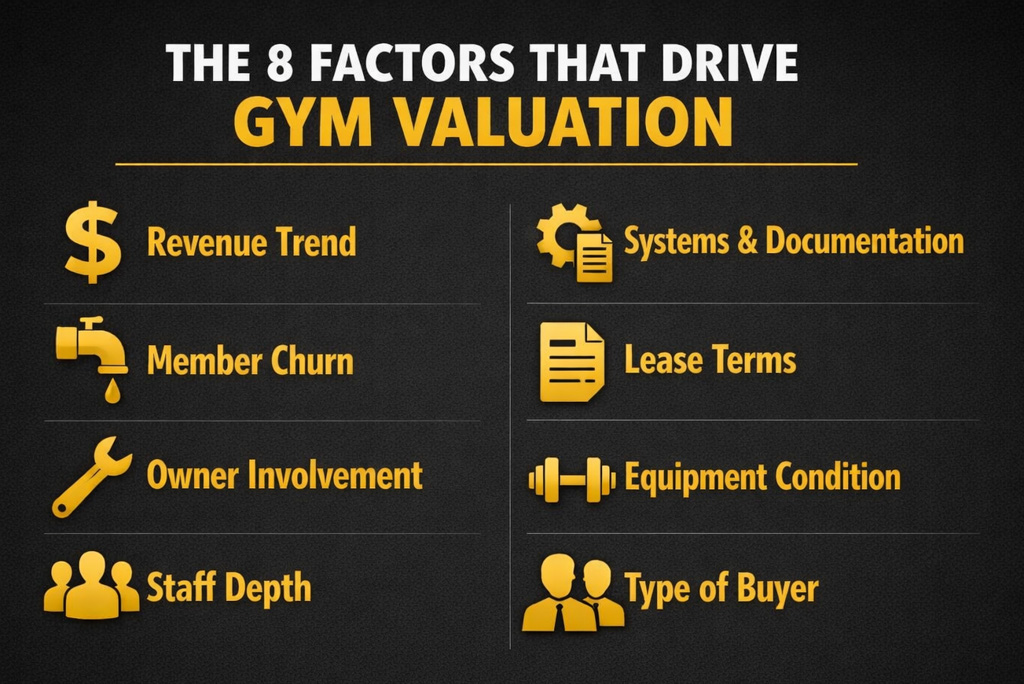
The 8 Factors That Drive Gym Valuation
Here’s what pushes the multiple up or down:
1. Revenue Trend
A growing gym is worth more than a shrinking one. Three years of consistent or increasing revenue signals a healthy trajectory. Declining revenue compresses the multiple significantly.
2. Member Churn
Monthly churn above 8% is a red flag—the gym is losing members faster than it can replace them. Churn below 4% signals strong retention, community and programming. This is one of the most important indicators of long-term business health.
3. Owner Involvement
This is often the single biggest factor. Ask the “three-month vacation” question: If the owner disappeared for three months with no contact, what would happen? If the gym closes, the multiple stays at 1x. If it runs fine, you’re in premium territory.
4. Staff Depth
A gym where the owner coaches every class is a liability. A gym with a full-time manager, trained coaches and documented roles is an asset. Pay attention to staff tenure—if coaches have been there for years, that’s stability a buyer can count on.
5. Systems and Documentation
If a new owner took over tomorrow, how much is written down? SOPs for onboarding, sales, programming, class management, billing and communications make a business transferable. If it’s all in the owner’s head, the value walks out the door when they do.
6. Lease Terms
The lease can make or break a deal. A long-term lease (five-plus years) with renewal options at reasonable escalation rates is a major asset. A month-to-month lease or one with fewer than two years remaining is a risk factor that suppresses the multiple.
7. Equipment Condition
Well-maintained, commercial-grade equipment retains value. Beat-up, residential-grade or outdated equipment is worthless and might require near-term replacement—a cost the buyer has to factor in.
8. Type of Buyer
Strategic buyers (like a competitor absorbing a neighboring gym’s members) will typically pay more than financial buyers (someone just looking at it as an investment). The value of the same gym can differ significantly depending on who’s buying.
What If the Gym Has No Profit?
A gym with no profit has no value beyond the liquidation value of its equipment—and sometimes less than that.
If the business is losing money and the owner is locked into a lease, the lease becomes a liability. We’ve seen owners of gyms with $500,000+ buildouts give them away for practically nothing because the lease liability was the real cost. The new owner walks in for next to nothing in exchange for taking over the lease payments.
This can actually be an opportunity for a savvy buyer with a turnaround plan—but it comes with significantly more risk.
Try the Calculator: What Is My Gym Worth?
We built a free Gym Valuation Calculator based on this exact framework. It walks you through calculating your SDE, scoring your business on the key factors and estimating your equipment’s liquidation value. Then it outputs an estimated valuation range.