
If you ask a world-class gym owner how they acquired so many members, you might be shocked at the real answer:
“Retention is really what gets us to that number.”
Not paid ads. Not clever guerrilla marketing campaigns. Not six-week challenges.
Retention systems.
“Boring!” someone calls out from the back—but that person will always struggle to get more than 150 clients in a coaching gym.
The quote above comes from Brian Foley, who owns Activate in Ireland—a gym with about 360 members.
Here’s the key to his retention systems (this is genius):
“Right now, we’re sitting in around that 360-member mark, but we’re planning our retention for 500 members. And when we were at 200 members, we planned for 350. We’re getting to the point now where our retention systems need an overhaul, and we’re always looking at them, and we’re always looking to improve them.”
Brian is planning ahead, not reacting. He’s building systems before he needs them, not after a disaster exposes a weakness.
Most gym owners never reach this level of clarity.
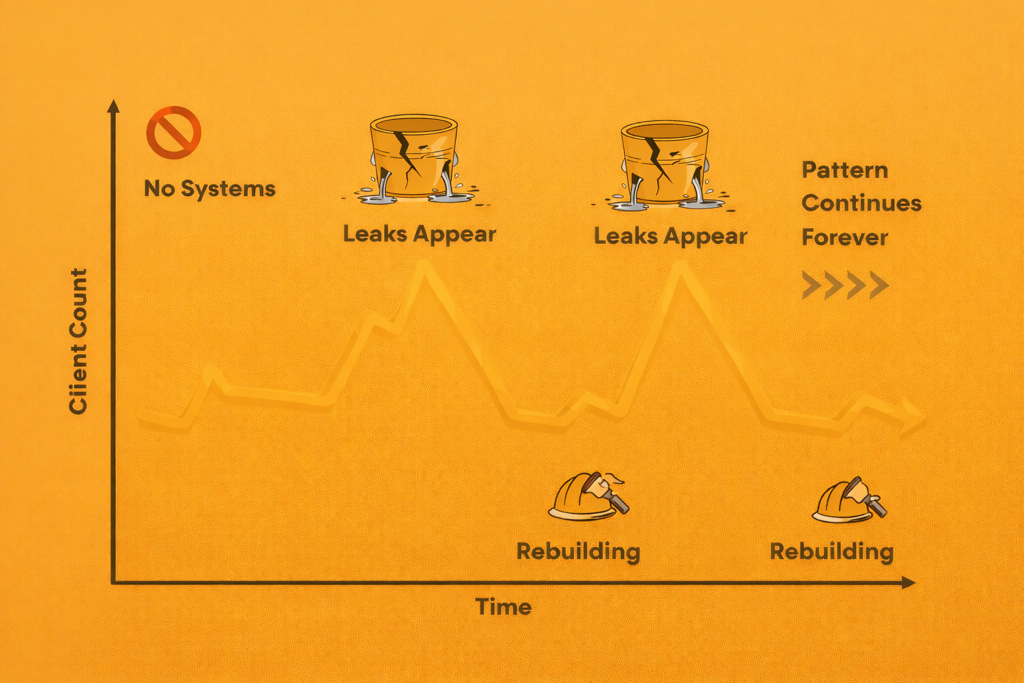
The Brutal Cycle of a Broken Gym
Here’s what’s common:
- Owner grows gym to 150 clients without systems.
- Owner holds everything together personally.
- Owner grows gym to 180 or 200 members.
- Gym starts to break, and members leave.
- Gym drops to 140 members.
- Owner chases wild marketing plans and spends more on ads.
- Owner grows gym to 180 or 200 members.
- Gym starts to break, and members leave.
- Gym drops to 140 members.
And so on—until the gym owner burns out or someone steps in to stop the cycle.
That person is a mentor—like Brian, who helps other gym owners through Two-Brain Business.
A World-Class Retention System
Here are some of the other key features of Brian’s retention system, which produces length of engagement (LEG) of 27 months:
- He has a fully mapped client journey from first awareness to final exit.
- He markets carefully to connect with the right people, not “all the people.”
- He uses a No Sweat Intro to ensure new clients get the service that’s right for them.
- He finds out about clients’ goals, as well as their FORD: family, occupation, relationships and dreams.
- He puts new clients through a one-on-one on-ramp.
- He holds weekly retention meetings with staff, who identify flagging attendance or other issues.
- He uses a client success manager (CSM) to run reports and solve problems before they produce cancelations.
- He runs quarterly bring-a-friend events that produce 10-12 clients each.
Brian gets his team involved in everything because he can’t serve 360 people by himself. While he was laying all this out on our podcast, “Run a Profitable Gym,” his team was literally across the hall working on retention.
Oh yeah—he’s built four marketing funnels: referrals, content, social media and paid ads.
But that’s not his No. 1 focus when he tries to improve his client count.
“Most people are working on the wrong problem all the time,” Brian said. “It’s, ‘How do I get more clients in?’ And they’re just filling a leaky bucket. … The most important thing is design and build a gym that no one wants to leave before you try to grow it.
“Get your systems locked in for a gym that’s far larger than where you currently are. Design your systems and your gym and your care network for a gym that’s larger than where you currently are.”
If you take nothing from this blog, take this:
Build retention systems for the client count you want, not the client count you have.
If you don’t, “more clients” will break the system. What works for 100 does not work for 200 and gets crushed by 300.
Build the foundation first, then scale up.
That’s good advice in every single part of your business.
To find out more about how a mentor can help you build all the systems you need to run a world-class gym, book a call here.