You’re the best coach in your gym. So everyone wants to train with you.
Your calendar fills up. That feels great, right up until your income hits a ceiling and you realize you can’t work any more hours.
Ryan Groshong knows that feeling well. When he started working with a Two-Brain mentor, he was coaching 63 sessions a week.
Today he coaches 8 to 10.
In that time, his gym went from roughly $17,000 a month in revenue to more than $42,000. Last month, he paid his coaches about what the whole gym used to bring in before he joined Two-Brain.
And he did it while handing off clients he’d trained for almost a decade.
Here’s exactly how he did it.
Engage Fitness: Quick Profile
- Location: Kalispell, Montana
- Model: Premium personal training, plus semi-private, a small early-morning group and online nutrition
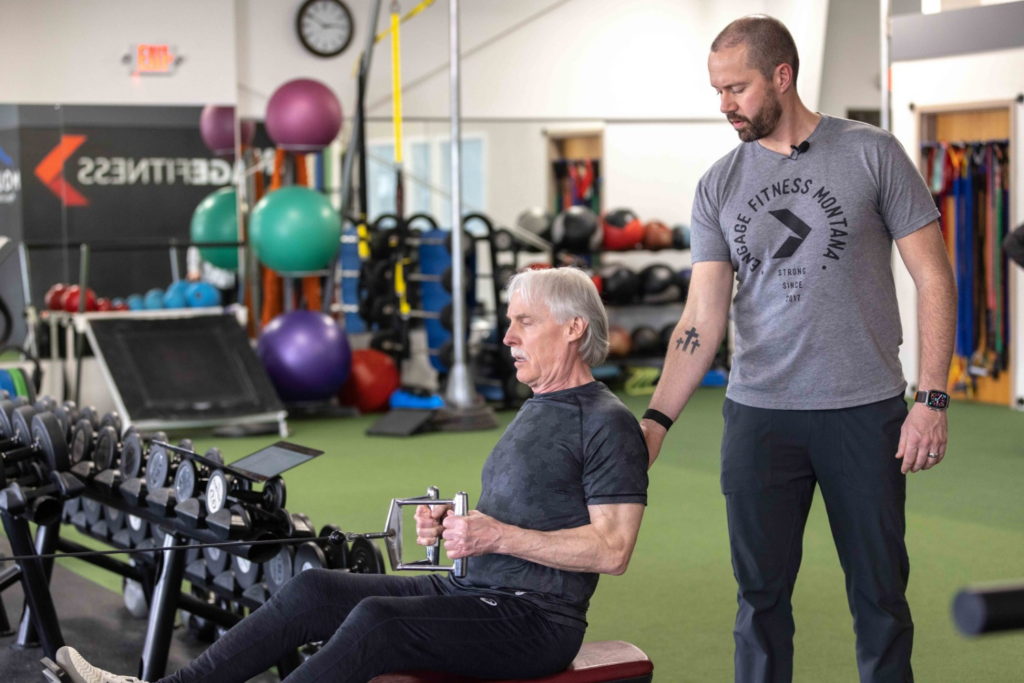
- Avatar: Business professionals aged 50 and up
- Marketing spend: $0. Every client has come from referrals and relationships.
- Revenue mix: About 50% personal training, about 40% semi-private, about 10% nutrition
Ryan didn’t come from fitness. He had a background in audio-video production, and after selling that business, he coached as a contractor at another studio for five years. When he opened his own gym, clients called him that same night asking to train with him.
Overnight, he went from the mid-30s to 63 billable hours a week. All one-on-one.
He knew it couldn’t last. So he brought on contractors and kept going on his own for five years, until he hit a ceiling he couldn’t get past.
A gym-owner friend put it bluntly: Ryan had hit his “level of incompetence.” He’d taken the business as far as his own knowledge could carry it.
Ryan almost didn’t call Two-Brain. He thought our advice was all for CrossFit and big group gyms. Then he heard mentor Joleen Bingham talk about running her own personal training facilities, and he booked a call.
Here are the five steps that took him from stuck to scaled.
Step 1: Switch Coaches From Contractors to Employees
When Ryan joined, he had three 1099 contractors. Clients came and went, and he didn’t have a name for that problem. (It’s called churn.)
The issue: Contractors are legally their own small businesses. Ryan couldn’t control when they showed up, how they worked or how they delivered service. But every client they trained was still building or breaking his brand.
He’d spend time and money signing a client, sell that client to a contractor for $500 and watch them leave three months later.
With his mentor’s help, Ryan moved his coaches to W-2 employment. That let him set standards and a specific way of operating, so when he sold a package, he could almost guarantee the client would get results.
Step 2: Write SOPs for Client Delivery
With his coaches on staff, Ryan wrote standard operating procedures so every client got the same high level of service, no matter who coached them. They covered topics like how to train someone with a cranky shoulder and how to talk with a client’s doctor, PA or physical therapist.
Ryan compares it to a restaurant. People pick a restaurant for its reputation, and once they know they want the steak, they don’t much care who cooks it.
Personal training works the same way, as long as the results are there. Clients came to Engage Fitness for the results its coaches get, not only for Ryan.
Step 3: Hand Off Clients Deliberately
This is where most personal training owners get stuck. How do you look a client of eight or nine years in the eye and pass them to someone else?
Ryan did it gradually, bringing his floor hours down bit by bit. His process:
- Notice when a client clicks with another coach who understands Ryan’s programming.
- Run a few sessions in tandem.
- Talk with the client about what a transition would look like.
- Make sure the client is genuinely happy with the new coach before making it official.
His biggest move came recently. Ryan realized his daughter was starting middle school, and because he’d always coached 6 a.m. clients, he’d never been home on a single school morning through all of elementary school.
That was a strong enough reason to tell six early-morning clients he needed to make a change. Four moved to later sessions so they could keep training with him. The other two, a nine-year client and a six-year client, moved to other coaches. Both told him they supported the decision.
Because Ryan was honest about his reason (his family), the conversation was easy. They didn’t hear “I don’t value you anymore.” They understood what mattered to him.
He also noticed that those clients might actually be getting better service now. Their new coach can focus on them completely, while Ryan was always splitting his attention with running the business.
Ryan still coaches 8 to 10 hours a week, by choice. Some of those clients have trained with him for 12 and 13 years.
Step 4: Give Admin Roles to Your Best People
About two years ago, Engage Fitness stalled again, this time at $30,000 to $35,000 a month.
Ryan realized he was the bottleneck. Every decision, every dollar spent, every lead, every sale, every admin task and every client check-in went through him.
So he talked with each coach, found where they had talents he lacked and offered them roles on top of coaching:
- His longest-serving coach, with him for seven years, took on most of the admin work.
- Another coach became client success manager. (Ryan admits he’s not great at remembering the dates and details that make clients feel special.)
That freed Ryan to focus on sales, marketing and lead nurture. That’s when the gym moved from the low $30s to averaging about $40,000 a month.
Notice the pattern: Hiring coaches broke the first ceiling. Giving staff real responsibility broke the second.
Step 5: Add Semi-Private Training
For most of its life, Engage Fitness only offered personal training. Then a few clients asked whether they could train together.
Ryan’s first answer was “No, we do personal training.” Then he realized there might be something there.
Semi-private let him pay coaches better per session while lowering the price for each client. So he started pairing up one-on-one clients and inviting them to try it.
He expected clients to see less value. They saw more. Each person still got individualized programming, still got the coach relationship they valued and also got a training partner, some friendly competition and camaraderie.
Many of his longtime clients switched. Semi-private is now about 40% of revenue, and it’s where Ryan plans to focus next year.
What’s Next for Engage Fitness
For nine years, Engage Fitness has shared a 7,000-square-foot facility with a physical therapist. The gym has outgrown it.
Ryan just negotiated a lease on a downtown space with good parking and visibility, and he has two months to move in. Long term, he wants to double revenue again so he can buy a permanent home for the gym.
He’s also in Tinker, our highest-level mentorship group. Working with his coach, Kenny, on financial clarity, Ryan paid off more than $27,000 in debt in under six months. He now has zero consumer debt and is planning for investments, retirement and eventually that “forever home” facility.
His Biggest Takeaway
Ryan’s biggest lesson from Two-Brain: Mentorship brings clarity. As one of his early mentors told him, “learn cheaply what cost others dearly.”
If you’ve hit a ceiling and don’t know how to get through it, book a call with our team.
Getting a second set of eyes on your business might be the first step toward breaking your revenue plateau.