When I opened my first gym, I set prices the same way a lot of owners do. I looked at what the gym down the street was charging and knocked ten dollars off. It felt like a smart move at the time. It wasn’t. I had no idea whether that gym down the street knew what it was doing, and it turns out it didn’t.
If you’ve ever guessed at your pricing the same way, there’s a better method, and it comes down to one metric: revenue per session.
What Revenue Per Session Actually Tells You
Revenue per session (RPS) is how much money you generate for every hour a coach is on the floor. It matters because a healthy RPS lets you pay your coaches well, run fewer sessions for the same income and keep more profit for yourself. All of that adds up to a simpler business, and a simpler business is one you can actually run for the long haul.
To show how this plays out, let’s compare two common models: large group training and small group semi-private. For this comparison, large group means anything designed for more than six people, and small group semi-private means four to six people. The numbers below come from the State of the Industry, our annual report with Kilo and Wodify, built on data from over 7,000 gyms.
Two Models, Similar Funnels, Very Different Prices
Here’s what stands out first: The marketing funnel looks nearly identical between the two models. Large group gyms average around 31 leads a month, small group averages 33. Appointments run seven versus six. Close rates land close together too. Whichever model you run, you’re not getting a marketing advantage from the format itself.
Price is where the gap opens up. The median large group gym charges around $175 a month. The median small group semi-private gym charges around $399, more than double.
Usage stays consistent across both models too. Members in either model use their membership about eight times a month, roughly twice a week.
Why Session Rate Changes Everything
Session rate is simply how much revenue you generate every time a member shows up. You get it by dividing the monthly membership price by how many times that member uses it in a month.
For large group, that works out to $22 per session on average. For small group semi-private, it’s about $50, more than double the large group number.
Most large group gyms are running a small group experience, but pricing it like a crowd. Fewer members typically attend a class than the format was built to hold, yet the price stays anchored to what a packed large group class would need to earn. That’s not a reason to abandon the model—plenty of gyms run group training profitably. It just means you need to either charge more than the industry average or get more people in the room than the industry average.
The $200 RPS Benchmark
At Two-Brain, we consider $200 in revenue per session a healthy target for most gyms. At that level, you can pay coaches a wage that attracts and keeps good talent, keep meaningful profit for yourself, and know at a glance whether a given class on your schedule is pulling its weight.
RPS is calculated as session rate multiplied by attendance. Using industry averages, a large group gym with a $22 session rate and 6.6 people per class comes out to about $145 in RPS, below the $200 benchmark. A small group gym with a $50 session rate and 4.6 people per class comes out to about $230, above it.
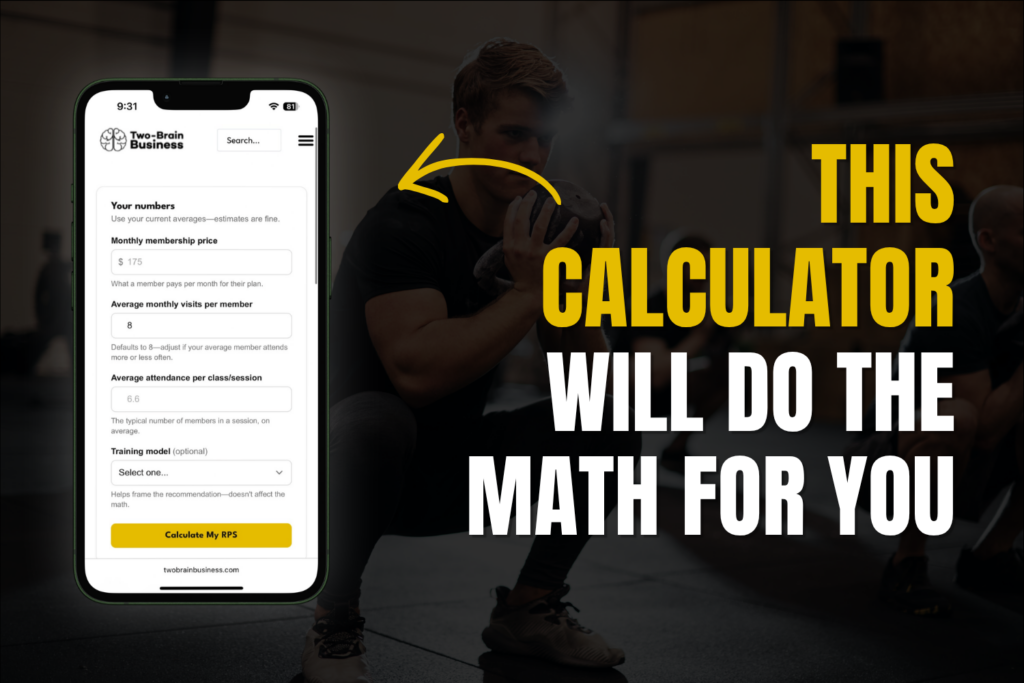
Want to see where your own gym lands? Plug your numbers into the calculator below and find your revenue per session.
Two Levers to Pull
If you’re running large group training and want to hit that $200 RPS target, you have two variables to work with: your price or your attendance.
If you assume your class attendance is going to stay right at the industry average of 6.6 people, you can work backwards to find your price. Divide your $200 target by 6.6, and you get a session rate of about $30. Multiply that by the average of eight visits a month, and your membership needs to be priced around $240, not the $175 industry average, to hit a healthy RPS.
If $240 feels out of reach for your market, the other lever is attendance. Keep pricing closer to that $175 average, and instead solve for how many people you need in the room. Divide your $200 RPS target by your $22 session rate, and you land on a target attendance just above nine people per class. Get nine or ten people consistently showing up to every class, and you’ve accomplished the same thing as raising your price to $240.
Either path gets you to the same destination. What matters is picking one on purpose instead of guessing at a number because it felt close to what the gym down the street charges.
By the way, the revenue per session calculator above will do all of this math for you so you can see exactly what pricing and attendance numbers you should aim for.
If you want help figuring out where your gym stands and building a plan to improve it, a Two-Brain mentor can walk you through the numbers and help you build a stronger business. Book a call to get started.